Showing posts with label information. Show all posts

Thursday, December 4, 2014

My Physical Therapist Says Part 9

Several weeks ago, I asked my physical therapist for more explanation of how working to improve *strength* will help my TOS situation.

With all the chronic muscle tension and spasm I've had for years, how can I work on strengthening- don't I need to *relax* the muscles?
PT said -"Think of it this way- compare muscle to a rope. You pull on the ends of the rope and the outer fibers are stressed and break.  Over the next couple days, as the recovery and healing takes place, is when you actually gain strength. You don't gain strength as you are stressing the muscle, but afterward, in the repair and recovery. Trust me on this, strengthening and stability are the keys to turning things around for you, but it's going to take time. It took a lot of time for you to get to this place."

I asked about how nerve pain could be reduced by strengthening when I am tensioning the muscle that spasms and tightens its grip on the nerve?!

P.T.'s response-"In a sense, you're right in your thinking; however, your nerve can be hyper sensitive. You use both your arms but the right tires faster and is more painful than the left, (my left arm is usually fine). It seems the nerve is maybe being grabbed by muscle more on the right side.


This journey is about the long haul for you not a quick fix. Keep going. 

You will have days when it flares, and it hurts, but keep going.

You have been very motivated and done the right things to affect positive changes, keep going. 

Things are really very different for you since the time you started here, your tissues have changed. TOS is a really difficult thing for P.T.'s. We have a hard time with that particular disorder, so all the things you have done on your own to change your situation has helped tremendoulsly. Keep going."

I've been trying to sit on my big exercise ball, balancing without touching the floor or the ball with my hands or feet. As soon as my feet leave the floor the nerve pain kicks in and gets worse the longer I stay there.
I asked P.T. why that happens.
"It requires core strength and you're challenging that with what you're doing balancing on the ball like that. Twenty minutes is too much; of course it would cause your pain to flare up." (which is a bummer because it's kind of fun).
I told him the fact that the pain kicks in the second I start balancing makes me think of the muscle that was removed from my neck, and wonder if that pain will ever really go away?
Response-"I dont know, but you are gaining strength, and your tissues have changed so much-keep going."

I hope all my fellow TOSers can glean some encouragement to *Keep Going* on your own TOS journey.

As always, Gentle Hugs~

Wednesday, September 17, 2014

Big TOS Medical word of the Day-Etilogical

Etilogical =

1.
a. The study of causes or origins.
b. The branch of medicine that deals with the causes or origins of disease.
2.
a. Assignment of a cause, an origin, or a reason for something.
b. The cause or origin of a disease or disorder as determined by medical diagnosis.

Friday, August 29, 2014

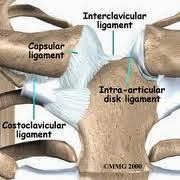
Big TOS Medical Word of the Day- Costoclavicular


Definition of COSTOCLAVICULAR

: of or relating to a ligament connecting the costal cartilage of the first rib with the clavicle


Friday, August 22, 2014

My Physical Therapist Says Part 6

I asked my PT what others living with TOS should look for in a physical therapist. He said no one else is going to do things exactly the way he is treating my TOS issues because everyone has different training and approaches. However,  if you look for a physical therapist who focuses on head and neck injury/trauma, that should be a good place to find someone knowledgeable about TOS. A main source my PT utilizes is the book Explain Pain, Butler, Moseley and information by noigroup.

Standing behind me, poking around my neck (cervial rib), shoulder area, PT commented-
"Your tissues have changed."
With a quizzical look on my face, I asked what that means.
Response-"When you first started coming here here I would just barely touch you here and get a response, it didn't take much. But your tissues have changed; the tone is much better, because you've been doing alot of different things to affect that change."

I mentioned to my PT about my daughters resistance to trying physical therapy (even though she really needs to). Response, "Well, I'm glad you're on board. You are in a good place to say to people living with TOS, "Hey, there's hope...it CAN get better."


Sunday, August 3, 2014

My Physical Therapist Says...Part 6

"Your body wants to move, its good for you to move. Garden, be as active as you can - without blowing up symptoms." 

I asked why when I do this-(arm up and down, painting motion) does my ear hurt?  Response-"because the pain is not coming from your ear its coming from your neck muscles."

"They've done MRI of shoulders with torn rotator cuffs on people who have full function. Others  who've been told they have torn rotator cuff but normal MRI experience pain and limitation. Being given a medical dx can contribute mentally to pain."

"There will always be some people invested in their negativity and pain. But you can chose to focus on the positive and keep moving gradually forward."

I asked, if I lean into the pain, tilt head toward pain, fold arm up, is that a bad habit? Response," it takes the tension off the muscle and nerve, so temporarily, no thats not bad." (note-temporarily).

Gentle hugs~

Wednesday, July 16, 2014

My Physical Therapist Said...Part 5

"It's hard to go slow, to progress at a slow pace. Not everyone can handle that."

I told pt about a stressful life situation I'm having to deal with currently. PT said "These little tests are good for you. Not that the situation is good, but life happens. That is the point of doing all this pt, so you CAN live your life and handle these things without blowing up into a five-alarm flareup."

"For a long time you were walking around like this (hunched, arm bent up), so for you to be doing the stretches you've been doing is great."

"Honestly, a big part of the change you're seeing is from changing your diet, losing weight, moving more, because your cells are turning over and you're rebuilding with new cells all the time. You're coming at this from all angles, which is what you need to do."

I mentioned to pt that someone made a discouraging remark to me when I showed them some of the exercises I'm doing. (They said I was doing old people exercises and not real therapy on machines lifting weights).
PT's response was -"Everyone has their own journey-from point A, to B, to C, and so on. Its not going to look the same for everyone. You've come a long way since you started this. Don't let stuff like that get to you, just keep moving forward."

Part 6 soon...gentle hugs~

Sunday, July 13, 2014

Big TOS Medical Word - Bilateral

bilateral (baɪˈlætərəl)
adj
1. having or involving two sides
2. affecting or undertaken by two parties; mutual: a bilateral treaty.
3. denoting or relating to bilateral symmetry
4. having identical sides or parts on each side of an axis; symmetrical

Wednesday, July 9, 2014

The Pain of being a Redhead

Researchers believe redheads are more sensitive to pain because of a mutation in a gene that affects hair color.

"The MC1R gene belongs to a family of receptors that include pain receptors in the brain, and as a result, a mutation in the gene appears to influence the body’s sensitivity to pain. A 2004 study showed that redheads require, on average, about 20 percent more general anesthesia than people with dark hair or blond coloring. And in 2005, researchers found that redheads are more resistant to the effects of local anesthesia, such as the numbing drugs used by dentists."

Full NY Times article here.

Friday, July 4, 2014

My Physical Therapist Said...Part 4

 I asked p.t. about my cervical rib being the source of my pain and if I am just wasting my time fighting against it doing p.t.  He asked how my symptoms are on the left side, which has a large cervical rib also. I rarely have symptoms on my left side, which he said indicated to him my pain is not with the actual cervical rib but the pain is of another nature and that there could still be improvement.

 I asked about my TOS pain issues being years in the making and how long would it take to work out of this pain cycle? Response-That is a valid question, I don't know.  I asked if it might take years? Response- I don't know, maybe (which had an inflection to sound more like probably).  But then what are my alternatives at this point?
* Give up, live with the pain, be limited...like I pretty much have been the last few years.
* More surgery, with all of those uncertainties and possible complications.
* Stick to the plan and try to do what I can to change things.

It's good you have the blog, online support groups. Your own kids deal with TOS, so you have to stick together. You're in this together.

In explaining the brains involvement in producing pain, he told me about having to remove a sliver for his young daughter. The first time, was a breeze. Second time, same tiny sort of sliver, but her reaction was dramatic. Why? Because the brain remembered and produced that response for reasons related to emotion and things other than the actual physical damage.

When I tell him moving certain ways causes pain...
Response-I believe you.

It's o.k.

Part 5..soon!  gentle hugs~

Saturday, June 28, 2014

Neuroma-interesting read...


"A Neuroma is a thickening of nerve tissue that can occur in various parts of the body. The thickening of the nerve that defines a neuroma is a result of thickening and irritation of the nerve. This compression created an enlargement of the nerve, which may lead to permanent nerve damage."

"Work by Wall showed that even when no obvious nerve damage occurred, any trauma could lead to disruption of nerve axons. This disrupted axon will then produce axon sprouts. These sprouts try to link up with each other and heal the nerve. If they do not link up with another sprout, some die and some lie there; if a collection lie there together they are known as a neuroma. However, it is clear that sometimes there are not enough axons to form any anatomical structure and this is a microscopic finding. However, this axon is exquisitely sensitive to noradrenalin, and any noradrenalin released in the area produces intense stimulation of the nerve, producing severe pain. This is made worse by light touch, stress and movement."

*My apologies to the author of the quote above, I am unable to find the source of this quote-but thought it was important to share.

Friday, June 20, 2014

Physical Therapy - Exercises

**This post is intended to share my experience of physical therapy for my TOS related issues. It may help you to know some things you might expect from physical therapy. This is not intended as advice. Please consult a professional for your own TOS issues.

Here is what my physical therapist has given me for exercises so far...

Chin tucks.
(This should be called the 'Chins tuck' because the exercise creates a lovely double chin affect).
I barely move my head at all, but pt explained to me how to do this exercise without the overworked muscle firing and tap into the deep muscle in my neck. This move burns up the back of my head when I do it-not fun! But worth it if it will help...which I'm told it will.


Neck ROM look left, look right-
Pretty simple, look toward each shoulder, slowly, hold a few seconds when you reach the point of slight resistance.


Arm bend-nerve glide-
For this one, I sit forward in a chair (or on the couch) and bend arm up, then unbend, or open up the arm, dropping down by my side but back just past my body, until I barely begin to feel that nervy sharp feeling, hold a couple seconds, then bend my arm back up.


Pelvic tilt-
Sitting in a chair, tilt pelvis forward, sightly, don't over extent, then relax and repeat.  I am very familiar with the pelvic tilt from practicing Feldenkrais and their pelvic clock concept.   I highly recommend this exercise to become aware of how the spine is all connected and greatly affects your thoracic area.  Side note-Sitting slouchy promotes compression. This pelvic tilt, if done slowly and with attention, can travel up your spine to open up the thoracic area.  It's nice.

Jaw stretch with tube-
I started a couple months ago with just moving my jaw to the side-it really hurt. But several weeks later, now I have a 3 inch piece of rubber tube I put in between my front teeth, roll jaw to the side then bite and hold 5 seconds, and repeat. I think this is targeting the jaw and referred ear pain. So far it is helping, I could not yawn months ago, but I can now :)


Shoulder squeeze-
Another pretty simple move, squeeze shoulder blades together, thinking of focusing on the lower part. This move kills for me, stretches neck muscles, makes my ear hurt.  I get jabby nervy pains in my neck while I'm holding the squeeze for 5 seconds, and my neck and shoulders throb for a while afterward-every time. Not fun, don't like it, but again, if it's going to help-I'll keep doing them.

Isometric shoulder strengthening-
Make a fist, gently push your fist into your opposite hand, hold 5 seconds, repeat 10x. Then grab fist hand by wrist and hold while pulling back with fist, hold 5 sec, repeat 10x.

Also, and probably most importantly, pt pointed out to me how to breathe properly to release tension.

I am used to lamaze type breathing, with a slow, controlled exhale. The new way I'm supposed to breathe is inhale fully for 3 seconds, hold for 3 seconds, then exhale forcefully-like a sigh, push the air out.
I've been combining this new breath with something a cognitive therapist taught me to do to help with chronic pain-to close my eyes, and as I breathe in, imagine the breath pulling together all the negative emotion, stress, and pain in my body into a swirling ball in the center of my chest, then imagine exhaling and blowing all that junk out with the breath.  (I imagine a swirling ball of gross back and green slimy negative junk).
Ok, that sounds strange, but it does kinda help.

That's my current list of exercises. Pretty simple, and they seem to be making a difference.

Gentle hugs~

Wednesday, June 18, 2014

My Physical Therapist Says...Part 3

 
After you do these new moves/exercises, when you flare up a little, don't get discouraged, hang in there. You'll get there. It may take quite a while for you to get the hang of it, you've been set in this pattern quite a while.
We want to retrain the muscles and the brain, disengage certain muscle from over firing and engage those deep muscles that for whatever reason, (probably trauma, whiplash, surgery) stopped working.

I expressed concern about the pain I feel (up my neck, sharp into base of neck) when doing shoulder blade squeeze exercises, because my surgeon said I should specifically avoid heavy lifting, pulling down, arms up or extended repetitively. I worry that I'm causing compression because of what I feel when I do the exercise. After a moment of silence, the response was, "...sometimes, when you are told something by a medical professional, a doctor, its not necessarily for the long term, but for the healing phase. Honestly, your painting a room (which I did last week) is way more motion than that exercise, so I wouldn't worry about it."

When I asked if being on traction diminishes ear/neck/head pain, does that mean there is something pinched in my vertebrae? "No. Your system, your nerves, are overloaded; like they are being irritated and rubbed by muscle fiber, but that's different from a nerve pinch."

Quite often he says: "It's o.k."
(sometimes I want to rip my crummy arm off and hit him with it when he says that, because it does not feel o.k....my fellow TOSers can appreciate that).
I do appreciate the reassurance, it's just been so many years of this deal that sometimes it's hard to trust that it is in fact, o.k.

That's good, you're on Healing Road now!

Part 4 soon, Gentle hugs~


Wednesday, June 4, 2014

My Physical Therapist Says...Part 2


 My p.t asked how I was doing at the start of a recent appointment.
I told him I was throbbing from driving to p.t. in the rain, because I hate driving in the rain. I explained that it was raining the day of the car accident I was in 10 years ago.  I believe that accident was the precipitating factor for my TOS issues and I've not been the same since.
He was quiet, started poking around my neck, doing his job.
A minute later it was still quiet, he said...
Ever stub your toe going around your bed?
*sure (I wonder why he's asking).
How many times have you stubbed your toe going around your bed?
*a few (really wondering where he's going with this).
How many times have you gone around your bed?
*lots, every day.
Silence. I think about that for a minute while he pushes on spots in my neck.
(point taken). I need to relax.
Odds are in my favor I'm not going to have a car slam into me again because it's raining, or stub my toe on on the bed.

I hope he doesn't charge me Dr. Phil's rates for that moment of reflection.


  This is a road you're on and the biggest hurdle is mental, getting past that to keep on moving, gradually, forward.

  When you do these simple exercises or moves I've given you, and doing them causes pain, you need to know you are not doing damage to yourself. You are challenging the system, the muscle, nerves, and they may be upset and you may experience some pain. We don't want you to piss them off by doing too much and cause a five-alarm flareup, but we do want to challenge them and keep gradually moving forward, increasing your tolerance level.

  This is a journey for you.


Next week, a review of a p.t. recommended book: Explain Pain, Butler, Moseley

Gentle hugs~

Thursday, May 29, 2014

My Physical Therapist Said...


I was referred for another round of physical therapy with someone new several weeks ago. The approach has been different from my previous experiences with p.t. and I've gleaned a few things I'd like to share with my fellow TOSers. I trust you will find some helpful, and hopeful information you can apply to your own TOS situation.
Stay tuned for more posts of - My Physical Therapist Said.

~ ~ ~

 You've been dealing with TOS and these issues a long time, you're pretty far down the rabbit hole. But you CAN snake your way back up out of it, it's just going to take time - and diligence on your part.

 Your sympathetic nervous system is set too high. Think of it like this: remember when you first started driving, and you saw an animal on the side of the road? You though-oh my gosh, I don't want to hit it!  So you swerved way around it. Now, after years of driving, same situation, you just ease over a bit and don't get as alarmed. Your nervous system response, and thus pain response, is currently set to go off at the 'oh my gosh' level with the lightest stimulation, and we can work toward normalizing that response.

  Eventually, you can get to a place where you engage your nervous system and not have the five-alarm reactions.

  You felt that five-alarm flareup after the last therapy session, but then...you were o.k. Your motion is better today. When you do these movements I've given you, and you experience some pain afterward, your arm/ear/jaw isn't going to fall off, you are not doing damage to yourself.

  Your cells turn over constantly.You can affect positive change in your cells and structure. It's a gradual thing.

  This is a process for you, but you can do it.

~ ~ ~

Stay tuned for 'My Physical Therapist Said'...Part 2- coming soon!


Wednesday, April 9, 2014

TOS reading - ebook

http://www.docstoc.com/docs/126375816/Thoracic-Outlet-Syndrome

Good, concise information on TOS!
If you're new to TOS and want to understand what is involved in testing, diagnosis and treatment, this is an easy read and will answer most of your questions.

Friday, March 14, 2014

Big TOS Medical Word of the Day - Hyperalgesia

Hyperalgesia = increased sensitivity to pain or enhanced intensity of pain sensation

http://www.merriam-webster.com/medical/hyperalgesia

This happened to all three of us, the back of our arms have spots that are numbish, sensitive, hard to explain but we all have it. Maybe nerves were stretched and didn't fully recover postop? It's not a problem for us unless a dog or a kid or unknowing person taps or touches just the wrong spot on the back of the arm....eeek.

Sunday, December 2, 2012

30 things meme from invisibleillnessweek.com

Thankyou to invisibleillnessweek.com for making this available for those of us who deal with ongoing physical issues to participate in.


30 Things About My Invisible Illness You May Not Know

1. The illness I live with is: Thoracic Outlet Syndrome (TOS).

2. I was diagnosed with it in the year:2008?

3. But I've had symptoms since:1987

4. The biggest adjustment I’ve had to make is: Living with uncertainty; never knowing from one minute or one day to the next if symptoms may flare up.

5. Most people assume: That I am fine.

6. The hardest part about mornings are:Medication side effects-constipation, jitters, headaches, etc.

7. My favorite medical TV show is: Dr. OZ

8. A gadget I couldn’t live without is: Microwave lavender scented rice heat bag.

9. The hardest part about nights are:Sleeping comfortably.

10. Each day I take 5 pills and supplements.

11. Regarding alternative treatments I: believe in doing all you possibly can to help yourself, so I have tried many with mixed results.

12. If I had to choose between an invisible illness or visible I would choose:Invisible-though I'm not sure why.

13. Regarding working and career:I think about this daily-what could I possibly do for work??

14. People would be surprised to know:How much pain I put up with.

15. The hardest thing to accept about my new reality has been:Giving up on some dreams.

16. Something I never thought I could do with my illness that I did was:mow my lawn (riding mower).

17. The commercials about my illness:There aren't any.

18. Something I really miss doing since I was diagnosed is:Carrying a cute purse on my shoulder.

19. It was really hard to have to give up:My job doing home care for the elderly .

20. A new hobby I have taken up since my diagnosis is:Blogging.

21. If I could have one day of feeling normal again I would:Cry, because I wouldn't want it to end.

22. My illness has taught me:Resilience.

23. Want to know a secret? One thing people say that gets under my skin is:"Well, you LOOK good."

24. But I love it when people:Are respectful and gentle.

25. My favorite motto, scripture, quote that gets me through tough times is: "There's no use complainin', it won't change anything!" -Viv

26. When someone is diagnosed I’d like to tell them: Read all you can, network; educating yourself and understanding your condition is so helpful.

27. Something that has surprised me about living with an illness is:The limited options for help.

28. The nicest thing someone did for me when I wasn’t feeling well was:Feed me jello after resection surgery when I didn't want to move my arm.

29. I’m involved with Invisible Illness Week because:It affects my life and the lives of people I care about.

30. The fact that you read this list makes me feel:Glad that I could bring some awareness to TOS